James Patterson and David Ellis’s, The Murder House left us sitting at the end of our seats wanting more and more. The authors provide an intriguing story with many twists and turns, leaving us in the dark. Remember, “No one ever leaves alive, The house at Ocean 7 Drive”.
Plot
Patterson introduces us to Jenna Murphy, a former New York City cop trying to rehabilitate her career in the Hamptons. She is put on an investigation after a couple is murdered at the house on Ocean 7 Drive.
During the investigation, Noah Walker is considered a suspect in the crimes. Jenna must dig deeper to determine who is responsible for the multiple killings. Jenna quickly realizes that the mansion’s history is much darker than she thought. Not only does she have to open the key to her past as a child, but she has to deal with grief and loss.
As a detective, Jenna doubts that the police have arrested the right person. Jenna doubts Noah Walker’s guilt, and she then expands her investigation to Aiden (cemetery caregiver) and one of her colleagues Issac Marks.
Patterson and Ellis bring us to the courtroom to figure out this hard cold-blooded case. These authors write great chapter cliffhangers, including a short conversation with one of the characters after being tortured and shot five times. Is Noah Walker responsible for it all?
This novel will keep you guessing until the end.
Character development
Patterson and Ellis create characters who are pertinent to the story. Even with her drinking faults, Jenna Murphy is perceived as an intelligent, determined, empowered woman, and she is the type of character who is not perfect.
Noah Walker is perceived as laid back but is also considered the primary suspect in the crimes. He is written as good-looking in the novel and projects certain innocence.
Isacc Marks is perceived as hostile towards Jenna once he becomes active chief of the Hamptons police department.
The character development is strong, and the reader quickly gets attached to the protagonist.
One character which could have been developed more was the man Sulzman who was blackmailing one of the characters. The reader never hears more about the man, even though he resents Noah Walker. This character could have created another excellent plot twist within this story.
Themes/symbolism
One of the themes mentioned within this novel is corruption. Corruption is seen when Jenna Murphy is put on the witness stand during the Noah Walker trial. During the cross-examination, the reader discovers why the protagonist was kicked out of the NYPD. In this part of the novel, we find out how Jenna resigned from her position and was being investigated for skimming money and drugs during an arrest of a drug dealer.
Another moment within the novel that mentions corruption is when one of the political powerhouses starts to blackmail the police chief.
Another theme explored in this novel is trust and honesty. Trust must be earned, and actions between the characters allow the protagonist to discover who she can trust.
Entertainment
While reading this story, I found it captivating how the author wrote from different characters’ points of view. At one point, the reader gets a glimpse at the murderer’s perspective, leaving the reader with many questions and goosebumps.
It is also intriguing how the plot allows for assumptions questioning whether the need to kill is genetic. The authors create many plot twists, and this one is the most entertaining, and it leaves the reader questioning whether generation after generation of men kill because it is in their bloodline.
Conclusion
In conclusion, it was a pleasure to read this novel. It kept us on the edge of our seats. It was packed with cliffhangers, plot twists and mysteries on mysteries. Not only did the reader get a glimpse of the protagonist’s point of view, but also the reader got a glimpse of the murderer’s. The themes of corruption and trust are found within this whole novel. Also, the reader can question whether murder is genetic. This book is mysteriously suspenseful and is a definite page-turner.
Therefore, with all these points examined from plot to entertainment, we grant The Murder House an impressive 5/5 stars.
Would a rose by any other name smell just as sweet? Would a poem by any other author evoke the same feelings? That’s the beauty of poetry, each is uniquely tied to the writer, and it offers a window into the soul, the poet’s as much as the reader’s. Bailey C. Weber, through the vivid images of flowers and nature, manages to evoke an array of emotions in her collection Tearing Petals of Beauty. The thoughts and feelings, mulled over after each page, were varied from one to the next. In this sense, the collection, while appearing disjointed at times, has succeeded in capturing the wonder of love and life beautifully.
It is clear that, when taken in totality, this book is a work of art. Not just to the extent that each poem or painting is an art piece, but that the amalgamation of each creates a sum that is greater than its parts. By association, this makes Weber a great artist. However, when taken individually, there are some poems and paintings that are stronger than others, which is to be expected in this ambitious undertaking.
One instance of a less appealing poem is found in Laughter’s Wrinkle. While it appears it is an image of loneliness and love-lost memories, there is a great deal of awkwardness within. “Not wanting to think Earth as part of space / I sit quietly with an empty heart / Money for the space race, I touch your face / We can’t eat money; power has no heart.” Admittedly, the awkwardness that we feel in this excerpt may be due to the inability to grasp the meaning Weber is trying to convey. We can only guess, but taken within context, it appears to us that she is making a juxtaposition between being powerless, and having power within a relationship. Earlier, the narrator concludes that she does not believe she has the power to change lives, and refers to herself as “just a girl”. Two lines down, it is emphasized that the narrator “needs a man”, implying that she is powerless on her own. In the previously quoted section, she says that she has an empty heart, while also stating that power has no heart. The fact that there is a void in her heart, where power is illustrated equally as nothing but a void, further illustrates her powerlessness.
The poem is redeemed in the final five lines, creating a beautiful picture of either a love long-passed, or an imaginary future love. Weber evokes a picture of crow’s-feet for us as the narrator smiles with her eyes and fears a wrinkle, bringing into question whether she is afraid of growing old and still being alone. These five lines serve to redeem the lines that came before, painting a vivid and distinct image that is engaging to read. The poem as a whole is still rather good, albeit one of the weaker entries due to its awkwardness. That being said, if this can be considered a weaker entry, the rest of the book is in good shape.
Each poem appears to be written in the form of a sonnet, often with an ABABCDCD…XX rhyme scheme. There are a variety of instances where the scheme, meter, and formula are broken. It seems that Weber was acknowledging the rules of sonnets, and straying from their limitations in favor of artistic expression. This exemplifies a boldness that is both admirable and inspiring. Weber also uses repetition sparingly and with great affect. Alliteration is used in a few entries and this was also brilliantly implemented.
If we were only to select a few poems to read and forgetting the rest, Iris, Weeping Like a Willow, The Oak and Aspen, and Resented Reincarnation are among our absolute favorites and are our must-reads in the anthology. While we would have been satisfied to read each on their own, they are best enjoyed while reading the entire collection and following the narrator’s story from Love Poems to Loneliness, and all the way to the end in Acceptance. The paintings in the final section did a great deal to add to the flowery imagery permeating the vast majority of poems. When these poems and paintings are taken together as two sides of the same coin, it is clear that Tearing Petals of Beauty is an evocative work of art and passion.
We would recommend this book to anyone that enjoys poetry (sonnets in particular) and are open to some artistic freedom with the poet’s embellishment on a traditional formula. Although some of the weaker pieces had an impact on the overall enjoyment of the book, as a whole, Weber succeeds at creating a piece of art that will leave a lasting impression.
The famous Inspector Gamache series is coming to the small screen. This new series may be viewed on Amazon Prime starting on December 2nd. After this, two episodes will be released weekly until the season finale.
In the Three Pines trailer we see Alfred Molina playing the role of inspector Armand Gamache. Alfred Molina has played as Doctor Octopus in Spider Man 2 and as Diego Rivera in Frida.
The series is reportedly loosely based on three of Louise Penny’s novels, drawing several murder mystery story lines from three of the novels and one novella. Previously reported in a Distractify article, the season will kick off with an adaptation of Penny’s second novel, A Fatal Grace. This series will be produced by Left Bank Pictures, the same producers for the show Outlander.
We are intrigued to see this british actor play the role of Inspector Gamache of the Sûreté du Québec. It begs the question, how will he bring the character to life? If his previous works are any indication of the quality of his acting, we are surely in for a treat.
Judging by the trailer, we will assuredly enjoy this book-to-television adaptation. But what about you? Do you think Molina can pull off a convincing Gamache? Would you be affected if the plot significantly deviates from Penny’s novels? Let us know by leaving a comment and we will be happy to respond with thoughts of our own.
Miracles in the little things, Like the lush scent after the rains Fall upon a forest’s bushes, Each leaf that the water pushes To the earth. And so they sag As each droplet comes to drag From the base, along the midrib To balance at the tip. Not yet knowing whether to hold or drop, Though gravity, the leaf cannot stop. Thus dampening not just plant, but ground Which is where seeds can be found. The stems will straighten when clouds clear, Drying them, like a single tear Upon the cheek of joy unbound.
So they say life is but a circle And their shade is but a hurdle For a sapling sprouts to size As the leaflets photosynthesize. In turn, they grow just as tall, As the thicket from which the drops did fall. Together they stand in pride Weathering each storm in stride. For underneath, their roots are strong, To each stem, twenty more belong. Far darker is the overcast, But darkened days cannot last. For with each day of rain, Comes the sun to break again. That this process is so small, I still think it to be a miracle.
Why do they call it Fall when it sounds much less sweet Than the crunch of autumn leaves under your feet. It should be called Rise, like your spirits after such heat Subsides, and the air feels brisk and so sweet. Sweeter still is the candy from a trick or treat, Or a pumpkin spice latté, that nothing can beat. The smell of dead leaves can be just as sweet, As a pumpkin pie that you cannot wait to eat. It’s been baking all day, along with the meat, Of a Thanksgiving meal that is almost complete. It’s just missing you, so please, pull up a seat.
And together we give thanks, for the Fall and the Rise Of the apples we placed in the sweetest of pies.
Chief Inspector Armand Gamache receives a phone call from Agent Nichol. Agent Nichol announces that a murder has been committed in a small village called Three Pines, which resides in the Eastern Townships, east of Montreal.
Gamache must put on hold his thanksgiving plans with his wife Reine-Marie to investigate the crime scene. Reine-Marie accepts the high demands of her husband’s job and supports him; this, in turn, creates a strong bond between these two characters. Penny discusses their 32-year marriage together, “After 32 years of marriage he still couldn’t get enough of Reine-Marie […] he trusted her.” (p.91-93, ch.2). The strong bond between husband and wife shows the ideal for a relationship.
Armand Gamache has a high-demand job, and Reine-Marie is proud of what he does. She would even like to hang his framed commendations, but this reminds Gamache, of memories, of the faces of the dead and the living they left behind. (p.96, ch.2). He doesn’t view his commendations as the happy formal Surete ceremony, and his commendations remind him of having a challenging job where he loses colleagues.
After receiving the phone call about the murder, the author introduces the rookie, agent Yvette Nichol. Yvette is seen as the youngest of her family, with high expectations from her father. “She exceeded every expectation, by qualifying for the Surete.” (p.98, ch.2). Her father, Ari Nikulas, even lied about her having an uncle, Saul, who was killed by the authorities. The author lets us know her father’s guilt for lying to her because there was no uncle Saul. This lie was supposed to make their lost family sound heroic, but also it encouraged his children to reach their goals. This led Yvette Nichol to work in a dangerous field for the Surete du Quebec.
Agent Nichol counts herself as fortunate to be working with Gamache because he is a senior inspector with an excellent reputation. Agent Nichol picks Gamache up at his house. They then head to Three Pines together. Penny then adds descriptive writing to engage the reader in the scene where Gamache and Yvette Nichol encounter, “After a tooth-jarring minute or two along the washboard dirt road, they saw the inevitable paradox. An old stone mill sat beside a pond, the mid morning sun warming its fieldstones. Around it the maples and birches and wild cherry trees held their fragile leaves, like thousands of happy hands waving to them upon arrival. And police cars. The snakes in Eden. Though, Gamache knew, the police were not the evil ones. The snake was already here.” (p.105, ch.2). Gamache and Agent Nichol arrive at the crime scene to meet a crowd of anxious individuals from the village.
Armand Gamache then introduces Jean Guy Beauvoir and meets the duty officer from the Cowansville Surete office, Robert Lemieux. Jean-Guy has been Gamache’s second in command for more than a decade. Gamache then asks questions to Robert Lemieux to figure out if anything was weird when he arrived at the scene. Robert Lemieux then answers this question with a stereotypical answer about the English while pointing out Ben Hadley. He announces that the English have weak stomachs and that Ben was the individual who found the dead body.
Agent Nichol then misses a detail about how Ben Hadley was in the family for Hadley Mills, which she took hard and wondered what else she had missed on the scene. She was trying to receive approval from Gamache herself; she didn’t like how Lemieux was doing the same. This is shown when she looks suspiciously at Lemieux and dismisses him. (p.113, ch.2)
Gamache then stares quietly at Jane Neal. Examining her, it seems as if Gamache and Jane were frozen in time. The reader then gets a glimpse of how Gamache feels about the dead when Penny writes how he feels a pang when looking at the hand of the dead imagining all the people those hands had once held close. The detectives then try to determine the cause of death of Jane, and they question whether it was a robbery or was she shot by a hunter.
Dr. Sharon Harris informs the detectives of how long Jane Neal has been dead; she announces by at least five hours. She also tells them that there is an exit wound. Penny then describes how Jean-Guy feels the thrill every time Gamache asks him, “ ‘Tell me what you know.’ It signalled the beginning of the hunt.” (p.118, ch.2).
In the next scene, we have the conflict of how Yvette Nichol is struggling to find her place within the team. To impress Gamache, she interrupts a senior officer by answering a question that wasn’t directed at her. Trying to impress the other detectives as the rookie was doing the opposite. She wants to be right about how Ben Hadley is faking throwing up and how he should have realized Jane Neal was dead right from the start. Gamache then suggests that Agent Nichol was wrong and Ben Hadley was most likely in shock. “Here Gamache was inviting her to argue against herself. She didn’t want to. She wanted to be right. Clearly he thought she wasn’t.” (p.121, ch.2).
Gamache questions Ben Hadley and takes the time to listen to what had happened with no judgment. He was trying to understand who Jane was and what had occurred on his arrival at the crime scene. Penny then writes how Ben Hadley feels about Jane Neal, “ ‘ She was a wonderful woman. I wish I was good with words, I could begin to describe her for you.’ Ben turned his face away, ashamed of the tears that came up again.” (p.127, ch.2).
Yvette Nichol, as the rookie, is completely dumbfounded by how Gamache is treating their first suspect. She waited for Gamache to “set this stupid man straight.” (p.135, ch.2). She looks at Ben Hadley as an idiot who ran around a crime scene contaminating the whole site.
In conclusion of this chapter, Gamache then gives the news about Jane Neal’s death to the group of anxious villagers. Peter (Clara’s husband) then goes back to the church where Clara had stayed after church service, and Clara receives the dreadful news of her best friend’s death.
This month we picked an author well known for his psychological thrillers. This author’s books have been translated in over 24 different languages. We are proud to announce that the author of the month is Sebastien Fitzek, the first German author to be awarded the European prize for criminal literature. Sebastien Fitzek always serves us readers with impossible to put down thrillers. He packs his books with multiple plot twists that keeps the reader intrigued until the end.
Here is a glimpse of some of his books that we enjoyed this month:
SOUL BREAKER
Three women go missing without a trace, the women are dead, dead only psychologically. They are bodies without a soul. This psychopath is known as the “Soul Breaker”. He leaves his victims paralyzed and in a catatonic state. A day before Christmas the soul breaker strikes again, but in a psychiatric clinic. After a bad snowstorm that has cut-off the power and telephone communication with the outside world, the staff and patients are stuck there with the Soul Breaker in their proximity. Will they be able to escape?
PASSENGER 23
Martin Schwarz is a well-known police psychologist. Martins’ wife and son disappeared off a cruise ship around 5 years ago. Martin can’t seem to give up his search for answers on what has happened. He is contacted by someone who might have some information on where they may have gone. Martin then discovers that another mother and child pair have disappeared, causing suspicions to rise, of a serial killer on board. Will Martin be able to get to the bottom of this?
THE PACKAGE
Emma is the one that got away, the only survivor of a killer called “The Hairdresser”. Her husband and the police are not persuaded about the actual events of what happened. Emma then experiences the struggles of post traumatic stress disorder. Trying to get help from past events, Emma starts to isolate herself. On multiple occasions she questions her sanity. She takes in a package for one of her neighbors, but will she regret what she has brought into her home?
SEAT 7A
Martin Kruger is absolutely terrified of flying. His daughter Nele is about to give birth to his first ever grandchild. However, even though Martin has a phobia of flying, he is taking the risk to be there for his daughter. After doing research he finds out the seat 7a, according to the facts, is the worse place to be seated within a plane. He gives away his safest seat, filled with dread, he then receives a phone call. Nele has been kidnapped and the caller wants one thing. Martin must choose between saving Nele’s life or saving everyone who is on the plane.
If you couldn’t tell from the descriptions of the books above, Sebastien Fitzek has created some real nail-biters. Each of these works of art will have you on the edge of your seat, on a rollercoaster ride that you pray will end soon, only so you can jump back on to do it all again, and again… and again. You can’t go wrong with any of these select gems. Happy reading for the month of May!
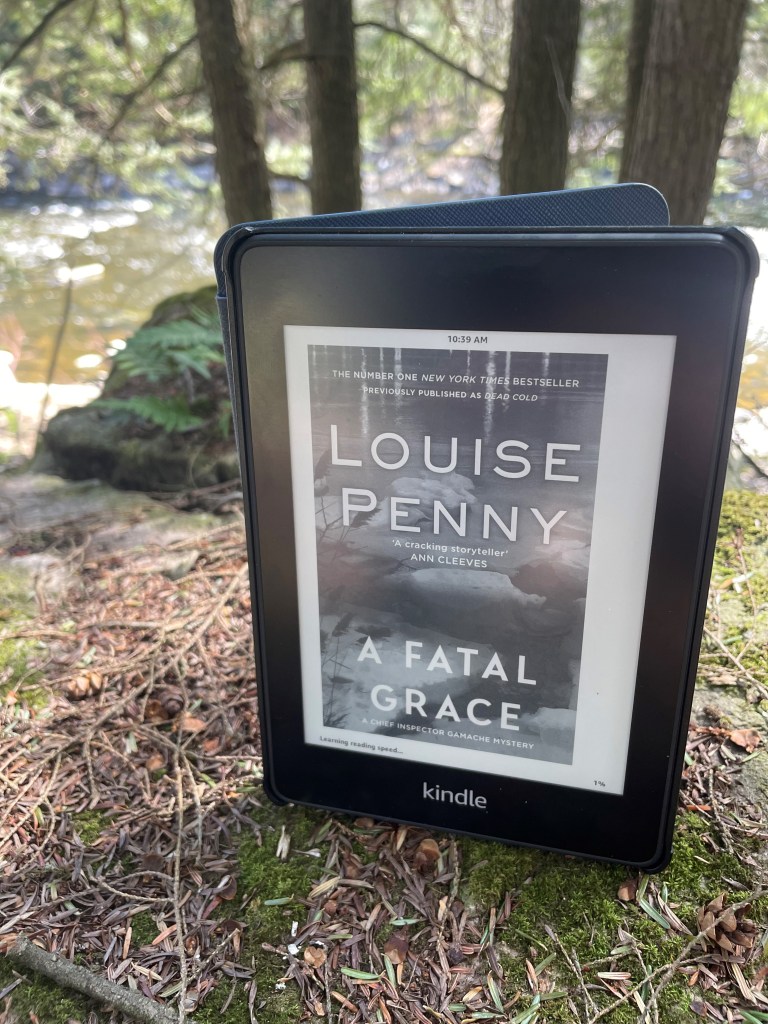
A Fatal Grace is a crime fiction novel. This novel is the second book of the Inspector Gamache series, written by Louise Penny. Another murder has occurred in Three Pines during the annual Boxing Day curling match. Chief Inspector Armand Gamache is called back to this little village which is now snow-covered. Armand Gamache has a challenge ahead of him; there are no witnesses and no clues despite the large crowd. Gamache discovers the victim has an extensive history of secrets and many enemies. He must decide who he can trust.
Plot
I much enjoyed this story’s plot. I found the murder crime was well thought out and well-elaborated compared to the first book in this series. When C.C de Poitiers got electrocuted, she was standing on a frozen lake watching a curling match. This accident made me curious about how the victim could be electrocuted on a lake. The murder is complex; however, it is well explained during the investigation. I also appreciated how Louise Penny included internal monologues of the characters, and it reveals how the characters feel and their thought processes.
I enjoyed how Penny included different subplots. For example, Penny introduced the murder in Montreal and the one in Three Pines. This left me wondering how the two crimes were interconnected. I enjoyed the storylines that included conflicts such as affairs, getting blackmailed, and trying to sabotage a career. The various stories within the larger plot created many rising actions, which essentially made me want to continue reading. Similar to the first novel Louise Penny kept me guessing until the end. Not just guessing, but Penny actually left me flabbergasted when she unveiled the murderer.
Character Development
I enjoyed how Louise Penny included the same characters as the first book within the series. It was less confusing because Penny had already introduced most of the characters. It was much easier to follow, and I didn’t need to go back to the beginning of the book to figure out who was who. If you are new to the series however, this novel might be a hard read because you don’t have all the information around all the characters.
Penny also makes the characters very realistic in this book. Gamache is the inspector who continuously attempts to see the good in people. Gamache is the sympathetic protagonist. C.C de Poitiers is an individual with many flaws and weaknesses. I enjoyed this because not everyone can be perfect in life. Penny also develops the characters in a way where we start to feel for them. For example, near the end of the novel, I felt empathy for Gamache and how much pressure he must have as a detective with a lot of responsibility. Also, due to making difficult decisions, some of the characters he trusts in the novel want to bring him down. I also appreciated how Agent Nichol comes back for this crime; we got a glimpse of what happened to her after being sent back to Montreal in the first book.
Themes / Symbolism
I believe that the theme of this book was perfectionism, particularly that nobody can achieve perfection no matter how hard they may try. This theme is seen throughout the novel when I discovered more about the victim, C.C de Poitiers. As a character, she strived for the perfection of life. She created a new philosophy and self-published a novel to gain money. However, she was very bitter and had anything but a perfect life. This imperfection is also demonstrated when Penny writes, “The chair was now out of alignment. She could feel a tension blossom in her chest. Damn him for deliberately annoying her like that […] C.C leaped out of bed and straightened the screaming chair, taking the opportunity to also move the telephone parallel to the edge of the desk.” (ch.3, p.67) This quote from the book demonstrates how the victim needed everything to be perfect and in place in her life. This exemplified traits or symptoms of OCD. She may have been struggling with her own imperfections. In this chapter, she talks poorly about Clara’s artwork, saying it was ugly. C.C de Poitier’s attitude toward others was flawed.
The Li-Bien ball (a glass ornament painted, by hand, on the inside) further solidifies the theme of perfectionism. The Li-Bien ball became one of the objects that encouraged C.C de Poitiers to create her philosophy of Li-Bien. The Li-Bien Ball, for C.C, was an object that inspired what would be an ideal life, to have a family and happiness. It was something special for C.C since it was the only thing she had to remind her of her mother.
Another theme I discovered was self-worth . The theme of self-worth is seen when Crie tries to prove herself to her parents. Penny writes, “No one ever saw her. It was the worst of all possible states, he knew, to never be noticed.” (ch.21, p.578) This quote describes how Crie must feel, unloved by her mother. During the book, she tries on multiple occasions to prove herself, at the church, during the play. It was never enough, though. Penny integrates subjects such as emotional and physical abuse of others. The search for self-worth was also demonstrated when, for the first time in 5 years, Crie participated in the school play. She wanted to prove to her mother that she was something in life. This is seen when Penny writes, “For the first time in her life Crie knew she was beautiful. And she knew, in just a few short minutes, her mother would think so too.” (Ch.2, p.41) Crie wanted to impress her mother to gain her approval and love. Without this, she felt worthless. I believe Penny is trying to demonstrate that we are worthy even if others don’t approve of the things we do.
Clara and the Three Graces’ artwork demonstrates imperfection. The imperfection is due to the crack in the art to let the light into the darkness. Clara states, “There’s a crack in everything.” (ch.21, p.603) which I believe means that not everyone can be perfect.
Writing Styles / Editing
I feel like the writing style hasn’t changed, and Penny still writes eloquently. This story is written from a third-person narrative point of view, and dialogue between the different characters allows for the plot to advance. I much enjoyed reading Penny’s work, and I did not find any spelling mistakes when reading. A novel that is poorly edited may become a distraction. I also appreciated how descriptive the writing was. I could imagine how things would look or smell in certain parts of the novel. This descriptive writing is demonstrated when Penny writes, “Inside the room smelled of wood smoke and industrial coffee in wet cardboard with a slight undercurrent of varnish and that musky aroma of old books.” (ch.14, p.385) An additional example of descriptive writing in this novel is when the novelist writes, “With each breath his nostrils froze shut and the air was like an ice pick in his sinuses, shooting pain through his forehead and making his eyes tear and freeze.” (ch.31, p.821). This quote is an excellent description of wintertime in Quebec. When it gets freezing outside, I know the feeling of the frozen air inside my nostrils all too well.
Entertainment
This novel held a great deal of entertainment value. It has many sub-plots leading to an exciting reading experience. Two murders and how the murder was committed were all so intriguing.
I also learned a lot about curling, which seemed like a boring sport, but with an explanation of the different terms, the skills (balance) required to play made me admire curling as a winter sport. I learned that the skip within a curling team is considered the team’s captain. (ch.17, p.457). I also learned that ‘clearing the house’ is a curling term where the opposing team’s “stone” shoots down the ice and hits as many of the rocks out of the house as possible. The house in curling is considered the “bulls’ eye,” the red rings painted on the ice. (Ch.17. p460-461).
I also recognized some anglophone vs francophone stereotypes. These stereotypes are seen when Penny writes, “Most Anglos, he’d noticed, didn’t like to raise their voices. Francophones were constantly gesturing and shouting and hugging. Beauvoir wasn’t sure why Anglos even had arms, except perhaps to carry all their money.” (ch.17, p.474). This excerpt is a stereotype of how English-speaking individuals in Quebec were a dominant working class. This increased francophone nationalism in Quebec. According to the Canadian encyclopedia, in 1961, the average salary of francophones was only two-thirds of that of an anglophone which validates the “carry all their money” comment from Beauvoir. This disparity between incomes has become less apparent since the quiet revolution (Donovan, 2019).
Conclusion
In conclusion, I thought the plot was well written, and adding different subplots , created more opportunities for cliff-hangers, which I enjoyed immensely. The writing style was descriptive and made me feel like I was walking through -26 degrees Celsius weather. It had great entertainment, and even a bit of humour was added by Penny when Clara is taking a bath from a bath bomb gifted by Peter’s mom. The characters were easier to follow during this book, and agent Nichol is reintroduced, which creates a great twist and potential future conflicts in the series. The themes were more complex, and certain touchy subjects were introduced, including emotional and physical abuse. Honestly, I was very passionate and satisfied with this book, it wasn’t a disappointment, and for me, it was better than the first book in the series. Therefore, I give this book a rating of 5/5.
How strange it is, that when we are born, We exit, then enter on the very same morn. And upon our grand entrance, we are met With sighs of relief, birthed by love, tears, and sweat.
This is a moment we are bound to forget.
Not long after, we babble and chatter Like a drunken buffoon, sounds that don’t matter. And through these sounds, we watch and observe, For soon we will speak our very first word.
This is a moment we are bound to forget.
Not long after, we crawl on all fours Tearing the rugs right off of the floors. And then we are bold, and dare to stand, Stumbling forward, toward an outreached hand.
This is a moment we are bound to forget.
So it seems there are a great deal of things That we will never remember, but the joy it brings To those who love us, and have always been there. How can such love be so common, yet rare?
The Watchers is an Irish horror novel created by A.M Shine. The forest in Galway is not seen on any map, and every car breaks down at its treeline. Mina is left stranded and is forced to walk through the dark, dreary forest. Mina finally finds a woman shouting, urging her to run to a bunker. As Mina arrives inside, the door slams behind her and the building becomes surrounded by unknown screams. Afraid and trapped, will Mina be able to escape this place?
Plot
The author creates a great reading experience by adding suspense to his plot. This is illustrated when the protagonist’s car breaks down, and she hears the first scream outside of her car. This element of suspense made me feel like the protagonist’s life was at stake but also left me wondering what and where the screams were coming from. “[…] When that shriek sounded through the night like a siren pinning Mina back into her seat […] Mina locked all the doors, feeling suddenly exposed. If there was something out there, then she sure as shit couldn’t see it. Her car was met on all sides by an impenetrable blackness, as though she had sunk to the ocean’s deepest trench, where old things live without time or light, in secrecy and in darkness.” (ch.1, p.77-79). After reading this part of the novel, I felt the suspense and fear Mina could have felt, hearing something unknown and strange. This element of suspense kept me engaged throughout the whole book.
Another element that made the plot more intriguing was the conflicts created by the author. This is seen when the author demonstrates the everyday obstacles the characters need to conquer to survive, such as getting water and trapping wildlife.
I didn’t particularly appreciate how there was a loophole in the plot. The loophole I found in this novel is when the protagonist reaches the bunker for the first time. I didn’t quite understand why the next day, the characters did not just follow the way Mina came from to escape. It took her half a day to reach the bunker, so logically if they just followed where she came from, they should have been able to escape the forest more quickly.
Also, I wouldn’t say I liked how the central part of the plot and story ended abruptly. I would have liked to have read more from the forest setting, and there could have been more opportunities for cliff-hangers and suspense within that setting.
Character development
There were not too many characters to remember, so that helped. The characters are entertaining, and the author did an excellent job of describing and revealing every character’s personality.
I enjoyed the overall character development. Mina was perceived as strong, independent, and intelligent. She was also seen as the second ringleader. Her intelligence is seen when she discovers the pattern of underground pits surrounding the bunker, created by The Watchers. Madeline’s character is perceived as bitter, unkind, and cruel. This is illustrated when she constantly insults Ciara and Daniel. This character often initiates conflict within the group, which gave the author opportunities to build suspense, resulting in climactic conflict resolutions. Furthermore, Madeline is perceived as the leader of the group making all the big decisions, and this is shown when Shine writes, “No one left the coop during the storm. Accidents and injury were too great a risk and Madeline wouldn’t allow it.” (ch 10, p.259-260)
Themes/Symbolism
I enjoyed discovering the theme of this novel. The theme of this novel is the fear of the unknown. This is demonstrated when Shine writes, “[…] ‘let’s go on an adventure!’ She looked to him, lips lolling open, sharing that beautifully bemused expression she always did when he surprised her. […] Her eyes glance back at the television, almost sadly. She didn’t want this. John knew that.” (Prologue, p.18-19). This quote describes when John convinces Ciara to go for an adventure on a drive. However, Ciara was delighted with sitting at home on her couch watching television on a Sunday. She was comfortable and safe. This safety she created in her home built a fear of doing actions outside of her routine. John feels guilty for pushing Ciara outside of her comfort zone; a push which led them to the pernicious situation that they find themselves in. He regrets taking that drive. John’s regret is illustrated when the author writes, “John wished he had just held Ciara a little longer. If only he had asked her what she really wanted to do, not that he didn’t already know.” (Prologue, p.21).
Another theme example is shown when Shine writes, “Madeline unlocked the door without hesitation. […] The light never lied to them. But Daniel wasn’t so eager to step out. It was, after all, not quite daylight. Not yet. […] Daniel imagined the watchers lingering close to the surface as the darkness dissipated, hoping for him to abandon the coop too soon and to step within reaching distance of them. How deep would they drag him? Would anyone hear his screams.” (ch 5, p.177-179). This quote shows how fearful Daniel is to go out of the coop/bunker. He fears the unknown that lurks outside the safety of those four walls. The bunker now symbolizes security and comfort for Daniel. The fear of the unknown is scarier than fears we can identify.
Writing Styles/Editing
I enjoyed how the author created a very descriptive setting for his novel. This is apparent when he describes for the first time the forest “The forest was dark on the brightest day. It was as though its ancient trees hid some terrible secret from the sun, and so weaved their branches together, casting a black gauze over the sky. The light broke through here and there in thin, hazy pillars but these were too rare to ever bring warmth.” (prologue, p.8-11)
I also appreciated how A.M Shine wrote each chapter from the point of view of the different characters. This is seen when the author describes the point of view of Daniel and how he feels towards another character. “Daniel has his head lowered, willing Madeline to stop; wishing that he had the courage to stand up to her. Maybe he was a coward after all. He had run away from his father and given half a chance he would run away from Madeline too, taking Ciara with him.” (ch.5 p.182). This quote demonstrates how Daniel feels about Madeline and how she reminds him of his father. This also shows the personality of Daniel and how he lacks the self-confidence to stand up for himself, but it also reveals his strong connection with Ciara. This type of writing style continues throughout the novel, creating deeper character connections and leading to more opportunities for character development.
Furthermore, I was pleased with the author’s use of specific literary techniques. For example, when the author used the simile describing one of the characters. This is seen when the author writes, “The bald head was rounder as the moon, and just as pale.” (Ch.18, p.448)
Entertainment
The entertainment within this novel was excellent. I really admired how the A.M Shine included Irish mythology. I enjoy how the novel consists of the mythology of fairies and monsters in the forest who were banished from society, and how he describes The Watchers as wicked. “These things are wicked. They toy with you. It’s like they enjoy it.” (ch.18 p.465). It left me on the edge of my chair. I also thought that the ending of this novel was masterful and opened up an opportunity for the author to write another book.
Conclusion
In conclusion, this book was deft for a debut horror novel. The plot was spine-chilling apart from the loophole discovered in the story, the rest of the book kept me engaged with the rising action, but I did find it ended too quickly. There was more potential for suspense with the setting, and I found the main plot ended too quickly. The author did a great job of describing each character, and when he wrote from their points of view, were privileged with a glimpse of the character’s different personalities. The descriptive writing style also kept me engaged throughout the novel, and I felt like I was in the bunker with the characters. I thought it was exceptionally compelling to incorporate Irish mythology, and no other novel that I have read has used it quite as effectively as Shine. Considering all the elements such as plot, character development, themes, writing styles, and entertainment, I give this novel a 4 out of a 5-star rating.
This book makes me excited to see the other writing pieces from A.M Shine.














 Alexandre McGovern







 Beginning to End Table Books