
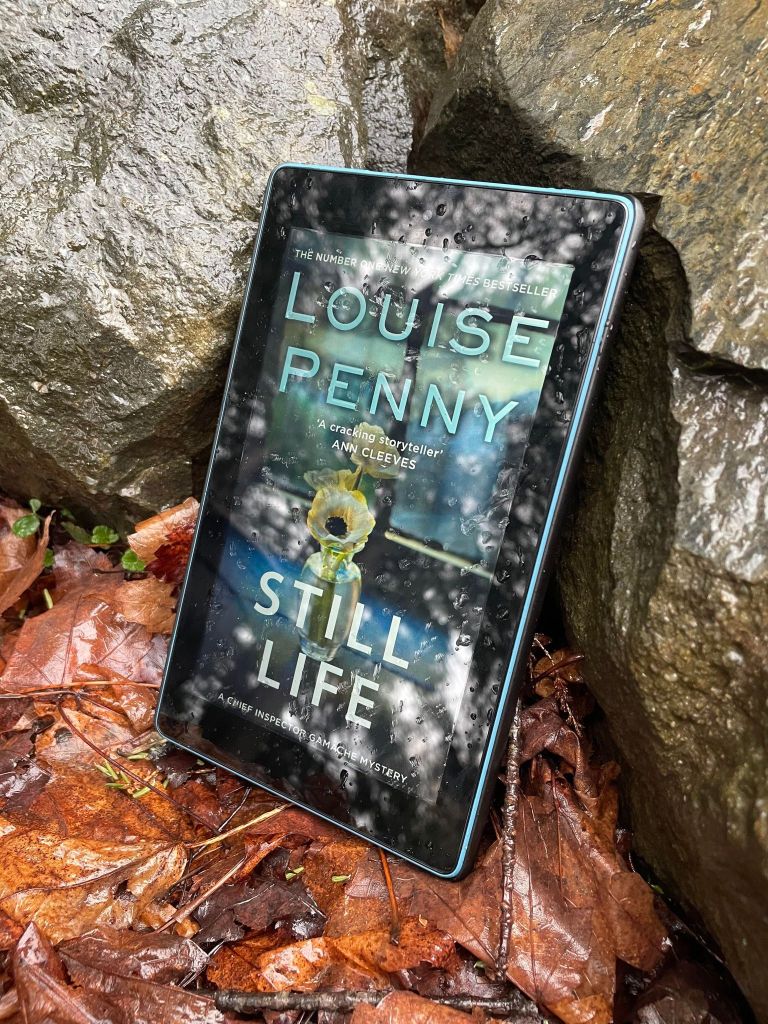
In Louise Penny’s Still Life, the reader is confronted by the death of Jane Neal in the opening paragraph. The author describes the lifeless body as eerily playful while also alluding to the transition from a mortal human to an angel. The concept of destiny is briefly mentioned, posing the question; are people merely subjects in the ebb and flow of time? Death is a certainty in everyone’s life, and the question demands if life is predestined.
The reader meets the main protagonist of the story, Chief Inspector Armand Gamache. His age is implied by cracking joints described in a simile, comparing them to the sound of a firearm being shot. His gifts in detective work are hinted at, and his gifts are compared to supernatural healing powers. He may not be able to heal fatal wounds, but his dedication is suggested as having healing properties, perhaps by providing closure to loved ones of the deceased.
Gamache is described as never getting used to the initial crime scene examination. No matter how long he has been in this field of work, death is always jarring.
We’re presented with information that suggests that the town of Three Pines is a quaint country town and the perfect destination for hunting. The small village seduces outside city slickers to put on their finest camo jackets and orange vests while prowling the woods for their next trophy. If prowling the woods means driving the back roads until they spot their target. They then parade the carcass around town on the hood of their trucks. In this sense, Penny appears to scrutinize the idea of killing for sport when she writes that these types of hunters believe “that the dead animal on the vehicle somehow announced that great men had done this.” This quote suggests that people committing such an act are, in fact, not great men, and it shines an absurd light on that belief.
Penny then segues into these hunters’ incompetence, shooting all manner of things that are not deer, opening the door to a dangerous recipe for disaster. The scene is set for the question to be posed; is Jane’s death a murder or an accident?
It becomes apparent that the novel takes place during the autumn, as Jane’s body is sprawled out on the leaves. The time of year is reinforced by the description of the brisk air and autumn chill that Jane walks in to arrive at her meeting with Clara (her best friend and neighbour). Autumn often represents sadness or change, and the town of Three Pines will never be the same; Jane’s death is both sad and a catalyst for this change.
Jane recounts a crime to Clara, who is surprised to hear of such an act taking place in this town. Three Pines is reinforced as a pleasant town that rarely sees acts of intentional violence. The idea that people only lock their doors to avoid an overabundance of kindness further solidifies the shocking nature of the crime Jane describes and the death the reader knows of. Instead, it is revealed that Jane is recounting a hate crime that she witnessed being committed by three young men against two homosexuals. Philippe Croft, Gus Hennessey, and Claude LaPierre are called out by Jane as the perpetrators, and they also become the reader’s first likely suspects in the death of their accuser.
Jane is revealed to be an artist. The scene cuts to the presentation of “Fair Day”, one of Jane’s paintings that she has finally mustered up the courage to show at the local art exhibit. Fair Day is described as a painting that evokes emotion. It is terrible to say the least, described as something a 4-year-old could out-paint. But in the evocation of a different emotion from each of the judges, it is finally deemed acceptable to be shown at the exhibit.
Penny neatly segues this scene with the introduction of one of her more outspoken characters. Ruth Zardo says “Hideous”, neatly tying the Fair Day scene with a pre-thanksgiving dinner. The subject of the hate crime that occurred against Olivier and Gabri, the two homosexual men previously mentioned, was discussed. It is reinforced that such a crime is uncommon in Three Pines, previously by Jane’s disbelief that it occurred at all, and now to Olivier’s surprise, that it hadn’t happened sooner. This creates a stark contrast between the perceptions of straight townsfolk and the homosexual characters themselves. It reveals that to truly understand the experiences and prejudice that homosexuals face, one would have to be homosexual. This is not to say members of the LGBT+ community cannot be empathized with and that people outside of the community cannot be allies. In fact, the friends surrounding and supporting Olivier and Gabri at this dinner are a testament to this. It simply means that a marginalized group knows best when it comes to the extent to which they are marginalized.
Around the table, still, Jane mutters that “evil is unspectacular and always human, and shares our bed and eats at our own table”. She is making an astute observation that there is darkness within everyone, but it also appears to foreshadow that Jane’s future killer will likely be one among the members sitting at that very thanksgiving feast.
The chapter concludes with Clara watching on, as Jane makes her way home. When she hears Jane’s dog barking, she understands that Jane has made it home. The final extension to this is the word “safe”, officially closing the chapter. An ironic observation that only the reader knows to be untrue.
Written by: Alexandre McGovern

 Beginning to End Table Books