
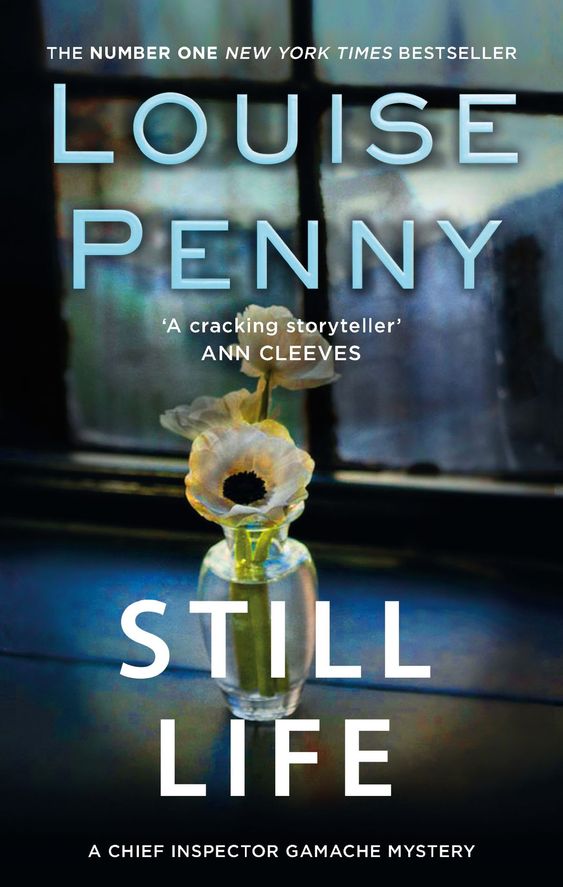
Still Life, by Louise Penny, is a crime fiction novel. In this book, chief inspector Armand Gamache from the Sûreté du Québec must investigate a crime within a small village in the Eastern Townships. Gamache tries to understand why anyone in Three Pines would want to kill a well-loved community member. Gamache knows that not everything is always as it seems, but he realizes that Three Pines will reveal its deepest darkest secrets if he watches closely enough.
Plot
What was intriguing about the plot was that it was attention-grabbing. I enjoyed how it always kept me on the edge of my seat. After every chapter, I just wanted to keep on reading more to figure out who killed Jane Neal. One flaw I noticed within this book was how illogical the plot was at times. A particular discovery occurred in the last few chapters that blew the doors wide open in the investigation. However, the way it was written, it seemed more like an afterthought, as if the author wrote herself into a corner and needed something to push the investigation along. Another vulnerability within this book was that there were not many chapters, and the length of the chapters was significantly prolonged. I noticed that chapters began to take longer to finish, but it didn’t detract from my overall interest in continuing to read the novel. This, though, is not the truth for everyone. Louise Penny could have had more chapters that were much briefer in length to deliver more cliff-hangers for the reader. Sadly, I would sometimes have to stop reading in a middle of a chapter, which decreases the overall reader experience of the novel.
Character development
I did not appreciate how Louise Penny introduced many characters. It was hard to keep up, and I found it unenjoyable when the author mentioned a character’s name, but I needed to return to the novel’s beginning to figure out who they were. Also, some of the characters acted hysterically at times which I didn’t quite understand. For example, Yvette Nichol acting arrogant suddenly or when Ruth acts hysterical in the bistro. At the beginning of the novel agent, Nichol seemed calm and very professional; she seemed content to be working in a team with Armand Gamache. As the book advanced, Agent Nichol revealed her genuine personality and finally, we see how she wasn’t a team player. When she was also making comments, we realized how unprofessional she was and outspoken, which eventually led Armand Gamache to make a hard decision.
I loved the character development of Peter Morrow. I admired when Peter asked what someone else would do when Clara was in distress and grieving over Jane for the first time in his life. In the scene, in the beginning, we see how he mentions he was jealous of the hold Jane had over Clara. Peter then decides to do what Jane would have done, and he lays down next to his wife and embraces her. “They settled, just for one blessed instant, on a place that held love, not loss” (Ch.3, p.238). This quote shows the love that Peter has for Clara.
Themes/Symbolism
What I appreciated within this novel is the symbolism. The symbolism that I enjoyed was of the hunting blind. The hunting blind symbolized a hidden identity within the small village. Clara also remarks that the hunting blind has an appropriate name since hunters who utilize the blind are blind to the cruelty of killing innocent animals. She implies that the hunters can not see the beauty within things. Penny demonstrates this when she states how hunters can not distinguish a tree from a partridge from a person.
One of the themes in this novel was judgment. This theme appears in the novel’s first part when Jane catches three individuals throwing manure at Gabri and Oliviers Bistro. Those three individuals passed a judgment due to these two characters’ relationship together. This activity within the novel demonstrates that judgement doesn’t always prove justice. Another example of judgment is when Armand Gamache observes the individuals’ actions, emotions, and personalities. His passing judgement didn’t have him expecting who the killer was.
Entertainment
I found this novel to be very entertaining. I learned a lot of things. For example, I discovered a lot about the different types of bows (recurve, crossbow, compound bow). Before this novel, I did not understand the difference. A crossbow is a bow that has a trigger to shoot the arrow, the compound bow has levers and pullies to help pull back the arrow, and the recurve bow gives a more significant amount of energy and speed while shooting an arrow.
What I also appreciated was how at the beginning of the book, the Québec culture is revealed. I was fond of how Louise Penny included some of Québec’s history, how francophones try to preserve their culture, and how many anglophones might feel about this. Penny illustrates this when Ben Hadley discusses how the English believed in individual rights and how the French felt like they had to protect their collective rights. This preservation of culture may cause anglophones to feel excluded.
What was interesting within Still Life was the ritual performed after Jane’s death. Where Myrna performs something called ‘smudging’ to cleanse away the evil spirits and make room for the good, they also had a prayer stick and tied, using yellow ribbon, all objects symbolic of Jane. For example, Myrna tied a book to the prayer stick and said, “This is for you, Jane, to thank you for sharing your love of the written word with me. Bless you.” (Ch.10, P.653)
Conclusion
Overall, this novel was well written. Louise Penny illustrated remarkable themes and symbolism within this narrative, such as the hunting blind and the theme of judgement. Although there were too many characters, the plot was confusing/illogical, and the chapters were lengthy. This series has excellent potential. The entertainment was incredible. Individuals who read this book will explore and learn about the culture of Québec and the different types of bows and arrows. Louise Penny kept the reader guessing who the killer was throughout the book. The narrative kept me engaged up until the end. With all these elements of the plot, character development, themes, writing style, and entertainment, this novel, on a 5-star scale, rates a 3.5/5.

Written by:
Elisabeth McGovern

Edited by:
Alexandre McGovern
 Beginning to End Table Books